Monday, August 8, 2011

"Reno Jim" Uprichard


Jim Uprichard, who tells me his last name is Welsh not Irish, has been a friend for 50 years.  He now lives in Reno, hence the moniker "Reno Jim."  That's him in the US Navy.  The two stripes means he was Admiral of the Second Fleet or something. He was also a boiler man on the USS Agerholm (commissioned in 1946, but sunk as a target off California in 1982).  A boiler man does what Steve McQueen does in the movie "Sand Pebbles."  That's a good movie. 

Reno Jim and I stay in touch as friends do, mostly out of curiosity to see how life turns for us. The guy in the Captain's hat is Jack Kerouac, the "beat" writer.  I didn't know Kerouac, but I think he may have tried to model his life after Reno Jim.  Uprichard makes Kerouac look like a Sunday School teacher.  The guy with the curly hair is Kurt Vonnegut, whose books I saw Reno Jim reading from time to time.  That's pretty much Jim's background, so far as I know.   


When Jim went into the Navy he had a metallic blue '56 Chev hardtop.  When he got out, he bought a purple VW bug.  Over the years, he's pretty much settled on a couple of Harley Davidson motorcycles. 

Reno Jim is an excellent rider.  When he sees a sign that suggests using caution, he'll grab a fist full of throttle and go even faster, lest some danger catch up to him from behind. The "dangerous curve" ahead sign is  biographical for Reno Jim.  

There are way too many stories and anecdotes to include here, obviously. 

This is a picture of Jim and I from the early 1970's.  I don't know who the women are standing next to Reno Jim in the pictures. 

That's Reno Jim with Ron Paul.  That makes perfect sense. 


UPDATE September 19, 2011--

Here's a picture of Reno Jim giving Senator Rand Paul a short seminar on the value of money and the dangers of the Federal Reserve this last weekend in Reno, Nevada (of course). 


UPDATE:  So Reno Jim was riding his bike around Florida in late summer 2012 to be a Ron Paul delegate at the GOP national convention, which he did.  But, he got banged up pretty good in a bike accident and ended in the hospital.  His bike got out earlier than him.  The "New World Order" trying to take him out?   His friends are trying to help him out.  For more info about this patriot, check out

Ouch-- that had to hurt, Reno Jim. 


Thursday, July 21, 2011

Denver Road Trip


"Rugged Individualism" is more than a myth.  It's something buried deep within our DNA, and if we're lucky we get to experience it once in a while.  It's related to challenge, stamina, adventure, self-awareness, self-reliance, survival and perseverance-- and all those things that comprise living.  It's not so much a goal or posture, but a glimpse at our inner potential.  Sure, there are ingredients of fantasy, day-dreaming, denial and rebellion-- but it's more a reaffirmation that we're not necessarily dead yet.   Without self-imposed tests, how can we truly measure our own ability?  Surely not by somebody else's standard. At least that's what I believe. 


So, a buddy (JJ) and I decided to go on a motorcycle ride from Seattle to Denver and back-- not the world's greatest or most daring and dangerous feat, but an adventure nevertheless.  If not at least that, then what?  If you ride, you know what I mean. 

We decided to  load up and take almost two weeks and head out for Denver.  We made the round trip, not staying in a motel or hotel once (although we did spend a couple of nights with friends).  It was mostly ride, fill up the tank, ride, eat, fill up the tank, find a campsite, etc.  Perfect!  That's JJ with the red bike. 


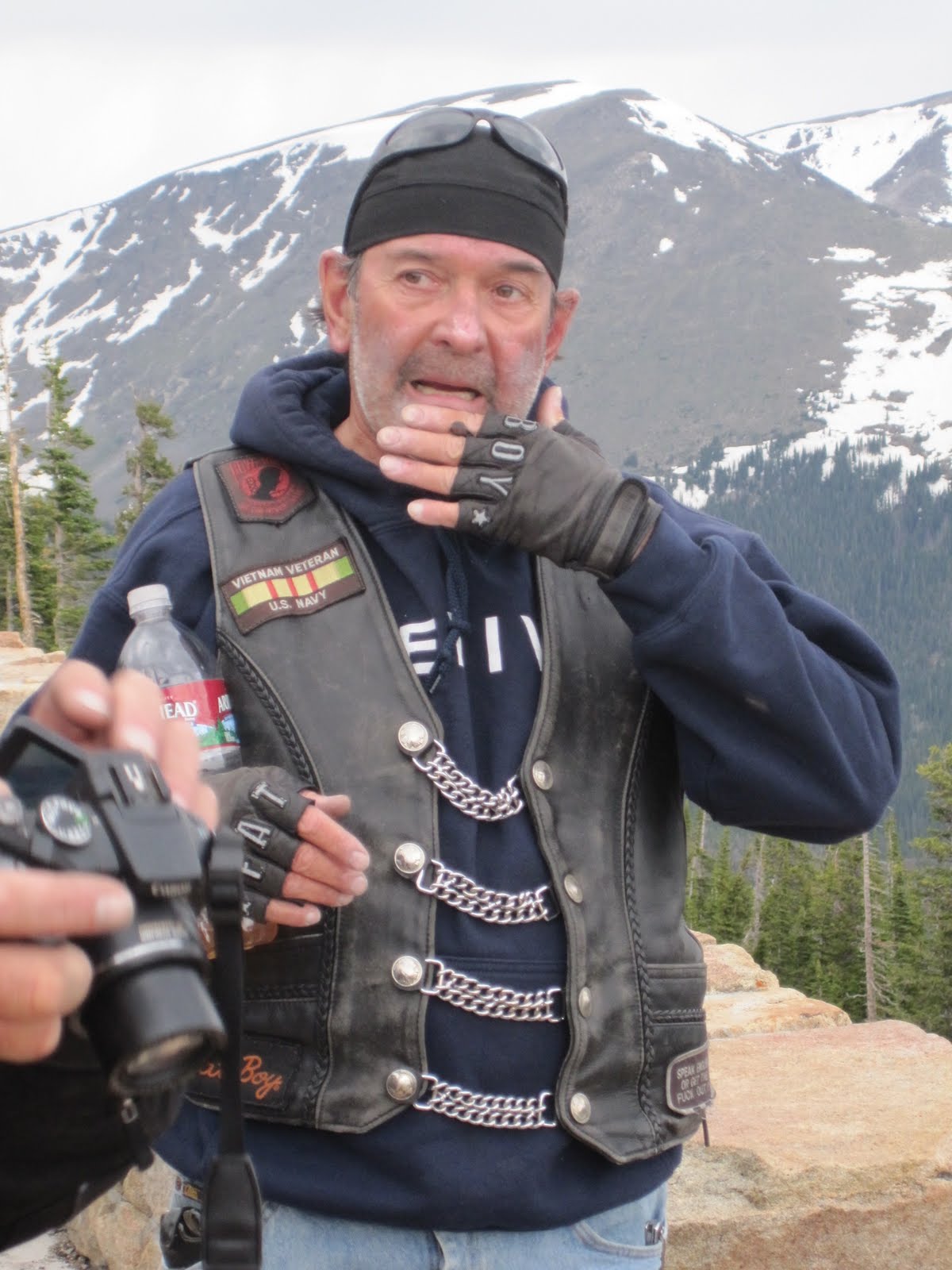
A week earlier, another buddy (Jim) had ridden from Reno to Minneapolis for a vitamin and nutrition convention, and he arranged to meet JJ and I just west of Denver. So, that made three of us. That's Jim with the black bike and all the gear on it.


JJ and I road to Pendleton, Oregon, the first night and then on to Twin Falls, Idaho, by the next evening. We stopped in Salt Lake (worst highway traffic on the whole trip). The third night was in Grand Junction, Colorado, and we met Jim the next morning in Rifle, west of Denver. That's the capitol building in Denver. After resting in Denver, it was on to Boulder and Estes Park in the Rockies.


There were broken kickstands, cops and traffic stops, lost chaps and shirts, bugs and animals.  The best story comes from riding down Granby Pass in the Rockies-- lots of herds of elk.  Anyway, Jim got stopped inside the National Park for speeding (and four other potential traffic infractions and one possible crime)-- but somehow he talked his way into a "warning" and we took off.  We then saw that Jim's headlamp was out.  It was getting dark and we needed a place to stay, but the best chance was 100 miles down the road.  So, JJ went ahead through the dark, followed by Jim without a headlamp, and then me.  Part of the way there was a pickup truck in front of us which tapped its brakes whenever elk and deer ran across the road-- and there were hundreds.  That was living!


We finally got into town and found we could stay in the city park if we first reported in with the sheriff.  The deputy assured us the sprinklers were done for the night, but they weren't.  We had to cover one with the picnic table and another with a garbage can.   


By then, Jim had been on the road about three weeks. No matter how much sun screen you apply, the road and wind will wear out your skin. That's Jim's ear. There's nothing quite like the elements to make you feel alive. We went on up to Rawlings, Wyoming. (Remind me to tell you about a murder charge I defended for Turtle Smith, who fled to Rawlings with a new notch carved in the grips of his revolver. The Wyoming State Penitentiary is in Rawlings, so maybe he was familiar with the town).


Next destination was Grand Tetons National Park and then on to Yellowstone National Park, to stay in Livingston, Montana, where Jim lived for seven years in the 1980's.  (Remind his cousin to tell us how the bullet hole got in the front door of that house).  That's the arch at the north exit of Yellowstone, south of Livingston.


We stayed with a friend in Wisdom, Montana, in the "Big Hole" and saw the 1877 Big Hole Battlefield, which was actually the site of a massacre of encamped Nez Perce Indians, fleeing the Army and hoping to reach Canada.  Chief Joseph led the survivors of his tribe away, but he soon surrendered and said  "I fight no more forever."  The site is a memorial to the slain men, women and many children.  See my earlier post about Levi McCormack. 
 

Wisdom is really small-- around 100 people-- but of those people, there was a famous guy living there named Carl Miles, who invented some Harley Davidson add-on parts, including the "Heel Guard."   That's me with him after I bought one of his parts and installed it (so I could eliminate my heel shifter).  I'm the one with the light beard.


It could be asked "Is that all?"  No, there was much, much more, but you had to be there.  These little self-imposed adventures aren't for everybody.  But, now and again it's just what the doctor ordered.  There you are, riding along in the sun and wind and rain and dust, in the moment.  And then you drift off into deep thought.  And then you get stung by a bee flying up your pant leg, back into the moment.  And then you start over again.  It was perfect!  Does that make sense?


Thursday, May 19, 2011

Porridge, Gruel, Grits and Lawyers

Porridge is a dish made by boiling rolled, crushed, or steel cut oats (or other cereal meals) in water or milk. It is usually served hot in a bowl or dish. Porridge is usually eaten as a breakfast dish, often with the addition of butter, sugar or milk.
Porridge was commonly used as prison food for inmates in England. Some call porridge "oatmeal." Oatmeal has a long history in Scottish culinary tradition because oats are better suited than wheat to Scotland's short wet growing season.


Gruel is a thinner version of porridge. It is made from some type of cereal (oats, wheat, rye flour or rice) usually boiled in water. It is similar to porridge, but more often drunk than eaten. It has a very thin consistency. Gruel consumption has traditionally been associated with poverty.

Grits consists of coarsely ground corn, usually prepared by adding one part grits to two-to-three parts boiling water and seasoned with salt, sugar or butter. Grits is common in the Southern United States, mainly eaten at breakfast. Grits can also be fried in a pan with vegetable oil, butter, or bacon grease.

Porridge can be found in popular literature. The Grimm Brothers,Wilhelm (1786 – 1859) and Jacob (1785 – 1863), were German linguists and researchers who collected old folk tales and published several collections of fairy tales, called Grimm's Fairy Tales. Jacob Grimm was also a lawyer.

There's a short story called "Sweet Porridge" by the Brothers Grimm:

There was a poor little girl who lived with her mother and they had nothing to eat. The girl went into the forest and met an old woman who gave her a little pot. When the little girl said "Cook, little pot, cook," the pot would cook sweet porridge. The pot stopped cooking porridge when the girl said "Stop, little pot." The girl took the pot home to her mother and now they were free to eat sweet porridge as often as they chose. One time when the girl went out, and her mother said "Cook, little pot, cook." The mom ate until she was satisfied but did not know the words to stop the pot from cooking. The pot kept on cooking until the little pot overflowed and the kitchen and whole house were full. The porridge overflowed into the street and into the other houses. The little girl finally came home and said "Stop, little pot," and the pot stopped cooking porridge, but whoever wished to return to the town had to eat his way back.

Just about everybody probably knows the story of "Goldilocks and The Three Bears."

There was a little girl named Goldilocks who went for a walk in the forest. She came upon a house owned by the Three Bears (Papa, Mama and Baby Bear) and walked right in. On the kitchen table there were three bowls of porridge. Goldilocks was hungry and tasted the porridge from the first bowl, which was too hot. The second bowl was too cold, but the last bowl of porridge was “just right.” She also tested the three chairs (breaking the smallest) and the three beds (falling asleep in Baby Bear’s bed, which was “just right”). The Three Bears came home and started investigating. Goldilocks woke up, saw the Three Bears and screamed "Help!" Goldilocks jumped up, ran out of the house and ran away into the forest. She never returned to the home of the three bears.
These stories are unusual, even for a lawyer-- Were they told to keep one's mind off of hunger? Why were little girls frequently wandering off into the forrest? Were these cereal meals always related to stories of hunger, poverty and subtle danger? Why are the endings so abrupt? What ever became of the little girls?

Yet, more recent popular "literature" continues to deal with these cereals and related themes.


Recall the 1992 movie titled "My Cousin Vinny," in which grits showed up. Vinny Gambini (played by Joe Pesci) was an inexperienced, loudmouth New York lawyer not accustomed to Southern rules and manners, who went to Alabama to defend two young men wrongly accused of murder while on their way back to college--


Vinny Gambini: You tesitfied earlier that you saw the boys go into the store, and you had just begun to cook your breakfast and you were just getting ready to eat when you heard the shot. Witness: That's right. Vinny Gambini: You remember what you had? Witness: Eggs and grits.Vinny Gambini: Eggs and grits. I like grits, too. How do you cook your grits? Do you like them regular, creamy or al dente? Instant grits? Witness: No self respectin' Southerner uses instant grits. I take pride in my grits. Vinny Gambini: So, how could it take you 5 minutes to cook your grits when it takes the entire grit-eating world 20 minutes? Witness: I don't know, I'm a fast cook I guess. Vinny Gambini: Are we to believe that boiling water soaks into a grit faster in your kitchen than anywhere else on the face of the earth? The laws of physics cease to exist on top of your stove? Were these magic grits? Did you buy them from the same guy who sold Jack his beanstalk beans?

Such is the reasonable connection between porridge, gruel, grits, danger, crimes, prison and lawyers.

Tuesday, February 15, 2011

"Walter the Penniless" and "Peter the Hermit"

Walter the Penniless was lieutenant to Peter the Hermit and co-led the People's Crusade at the beginning of the First Crusade (1095-1099).

The Crusades were undertaken by European Christians between the 11th and 14th centuries to recover the Holy Land, particularly Jerusalem, from Islam. The movement began in France when Pope Urban II exhorted Christendom to war, promising that the journey would count as penance.

The First Crusade (1095-1099) began with the march of several undisciplined hordes of French and German peasants (approximately 12,000 people, of whom only eight were knights), led by Walter the Penniless and Peter the Hermit.

Leaving well before the main army of knights and their followers, Walter led his band, traveling separately from Peter. They started out by massacring the Jews in the Rhineland (i.e., West Germany) and incensed the Bulgarians and Hungarians, who attacked and dispersed them. They reached Constantinople in shreds. Walter and Peter joined forces at Constantinople and crossed over the Asia Minor, and were promptly defeated by the Turks.

Peter the Hermit had returned to Constantinople, either for reinforcements or to protect himself. But Walter was killed, allegedly pierced by seven arrows. Peter returned to France and joined an Augustinian monastery.


There were nine crusades, plus the Children’ Crusade of 1212. Thousands of French children set out for the Holy land but were instead sold into slavery by unscrupulous skippers. Another group of German children made their way by land but perished of hunger and disease.


Sources: Will Durant, The Age of Faith; Wikipedia; Columbia Viking Desk Encyclopedia; Webster’s Collegiate Encyclopedia.